
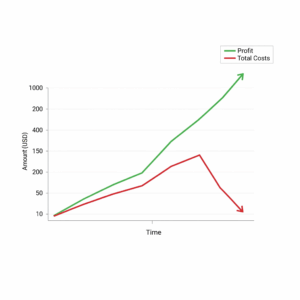
In the world of high-volume manufacturing, every detail of the production process impacts the bottom line. For decades, water-based die lubricants have been the standard, but their hidden costs—from fluid consumption to disposal—are becoming increasingly clear. Minimal Quantity Lubrication (MQL) systems offer a compelling alternative, providing not just environmental benefits but also significant financial savings. By making the shift to MQL, manufacturers can realize substantial cost reductions across a number of key areas.
Here is a breakdown of the potential savings, with rough percentages, when an MQL system is compared to a conventional water-based lubrication setup.
1. Fluid Consumption: A Near-Total Reduction
This is the most dramatic area of savings. A conventional water-based system uses a flood of fluid to cool and lubricate the die, with a vast majority of it being wasted.
Savings: An MQL system can reduce fluid consumption by 98% to 99%.
The Breakdown: While MQL lubricants are more expensive per liter, the system uses only a few milliliters per cycle, delivering a finely atomized spray directly to the point of contact. This precision delivery eliminates the need for large volumes of fluid, leading to a massive reduction in the overall fluid budget.
2. Disposal and Waste Management Costs: The Elimination of a Major Expense
Water-based lubricants become a hazardous waste stream after use, contaminated with metals, oils, and other particles. The collection, storage, and disposal of this waste are significant and often overlooked costs.
Savings: MQL systems can lead to a 100% elimination of waste disposal costs.
The Breakdown: MQL is a “total-loss” system, meaning the small amount of lubricant used is almost entirely consumed in the casting process. The chips and castings come out nearly dry, eliminating the need for expensive hazardous waste disposal, sump cleaning, and filtration system maintenance.
3. Energy Consumption: Less Power for the Same Results
Traditional flood coolant systems are energy-intensive. They require powerful pumps to circulate the fluid, as well as chillers and filtration systems to keep the coolant in usable condition.
Savings: Switching to MQL can result in a 70% to 80% reduction in energy costs related to the lubrication system.
The Breakdown: Because MQL is a near-dry process, it eliminates the need for coolant pumps and chilling units, leading to a significant drop in power consumption.
4. Post-Casting Cleaning: A Streamlined Production Line
Water-based lubricants often leave a residue on parts, requiring an additional washing or cleaning step. This post-processing adds both time and cost to the production cycle.
Savings: MQL can reduce or even completely eliminate the need for part cleaning, saving on labor, water, and energy.
The Breakdown: The near-dry nature of MQL means that parts emerge from the die clean and ready for the next stage of the production process, whether that’s packaging, assembly, or further machining.
5. Tool and Die Life: Extending the Life of High-Value Assets
The thermal shock caused by a flood of cold water-based coolant hitting a hot die can cause cracking and premature wear. This reduces the life of expensive dies and tools.
Savings: MQL can extend tool and die life by an estimated 200% to 400%.
The Breakdown: MQL’s near-dry process provides lubrication without the intense thermal shock of water. This leads to less wear and cracking on the die and tools, extending their lifespan and reducing the cost of replacements and maintenance.